


There is nothing quite like sitting down with someone and, in the space of a few minutes, creating an interactive tool or app that helps them solve the problem they’re currently working through.
If a picture speaks a thousand words, then a custom tool, built in real-time might speak at least ten times that!
Before you carry on, if you prefer to watch instead of read, I’m experimenting with video. Many are mash-ups of videos I send clients, others are new.
Whilst the tech community accelerates into the brave new world of agents and AI driven software-engineering, I’ve found there to be a bit of a content gap in how other smart people (outside this bubble) get started.
Perhaps the simplest way to put this is: it’s now possible to build useful software tools without writing a single line of code. If you can articulate something in natural language, you can now build a tool for yourself or your business.
And, though I’d push back on the narrative that you should go out and replace your entire software stack with a vibe-coded hobby project, there is immense value in learning how to solve firm-specific problems, or finally building out those 'nice-to-have' tools that never made the budget cut.
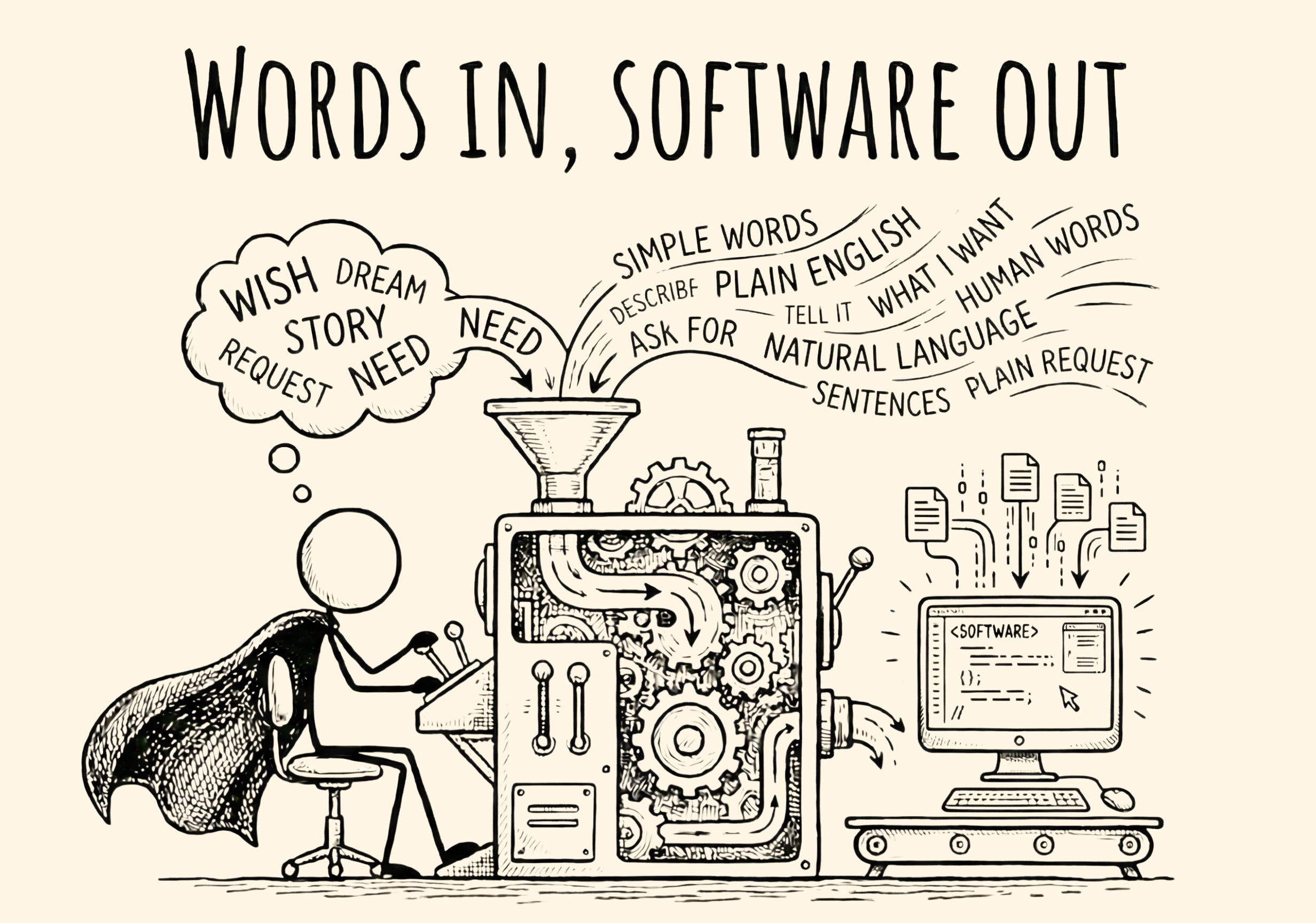
Whilst many engineers are cynical of this new trend, it doesn’t change the fact that, for the first time ever, people without any background in computing whatsoever can create software.
I do believe it’s easier for those with an engineering background to build applications with AI but it’s certainly possible for everyone to build something at this point.
So, what should you be building?
Well, I don’t think there is any one-size-fits-all approach here, but there are two (repeatable) patterns that seem to have worked really well for the SMB leaders I’ve been working with. Neither require a lot of time, money or resources to get started and, in most cases, so long as you can articulate your problem clearly, you’ll likely come out the other side with something pretty impressive.
Pattern 1 - Unlocking Underutilised IP
David is the MD of a fantastic US-based consultancy that helps other consultancies grow, win more clients and become more profitable. He has authored several books, regularly appears on podcasts and has an extremely large corpus of high-quality IP related to business development and scaling consultancy firms.
I’m working with David’s firm to look at both his internal operations and how we can use the firm’s existing IP to create even more value for his clients.
A few days ago, David asked how feasible it would be to create a tool he’s previously tried to build (several times) without a huge investment in time. The tool - “Vizidiz” - is a visual decision making tool that helps simplify complex decisions and rank candidates along multiple dimensions.
You’re assigning employee annual bonuses for dozens of staff and want a consistent approach to evaluating each person.
You have 10 vendors bidding for your new contract and want to make sure you pick the vendor that is, on balance, the best fit.
You have 4-5 technical approaches for a given engineering problem and want to rank-order them.
Or purely personal choices, like rank-ordering houses you want to buy based on safety, green space, and local amenities.
Because he’d never been able to produce a tool he was 100% happy with, this IP was just sort of sitting there. Such a shame.
David was able to provide a recording of an old presentation he’d put together on the topic, and sent me a couple of clarifying emails on the finer points.
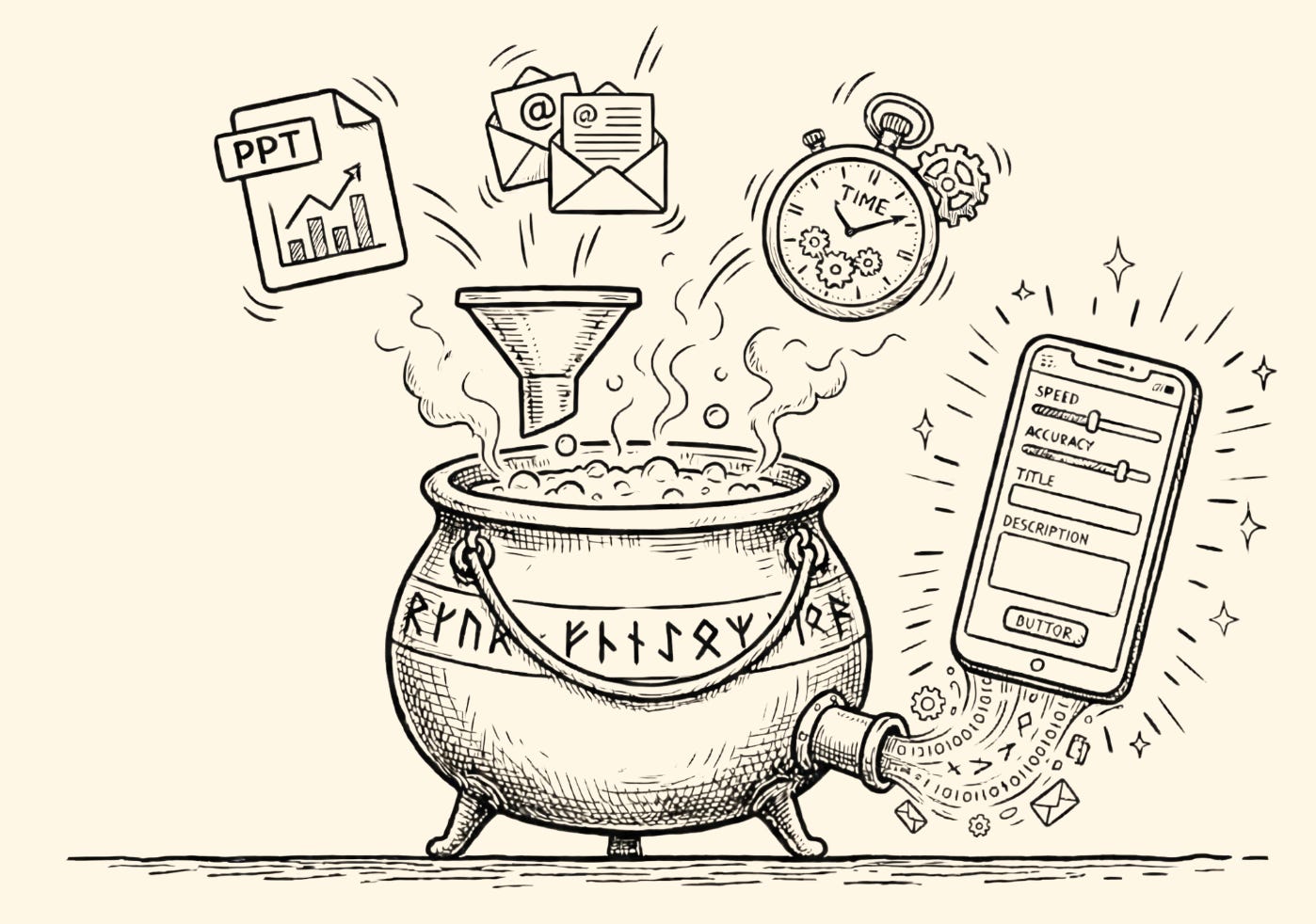
Only 15 minutes later, we were using the first version of the tool! From here we can incorporate it into the firms internal operations, product offerings and other learning materials.
I’ve left the original version we created here (warts and all). Try it out!
The point here is not the tool itself, it’s that the cost of running this experiment was so small that it completely changed the risk-reward ratio of this entire initiative.
Two years ago, this sort of experiment would have taken too much time away from other initiatives that it simply wouldn’t have been done. The value would have never been unlocked and a good tool would have continued to exist in theoretical-form only.
Where could you do this in your own business or team? What’s stopping you?
Pattern 2 - Back of the Envelope Analysis
Whilst David works predominantly in the knowledge-realm, Mark works mainly in the physical realm of nuts and bolts. Mark has a history of investing in alternative and distressed asset-classes and is constantly looking for ways to extract value from otherwise wasted resources.
I think it’s fair to say that Mark is still very early in his AI adoption journey - he knows it can be extremely powerful but is still figuring out how to extract that power in order to improve his business outcomes.
Naturally, in the physical realm, a failed project or experiment can be costly - in some cases, enough to put someone out of business. And, whilst we like to think, there is a lot of complex modelling behind every decision - the reality is that there just isn’t the time!
In this particular case, the question was whether there was any merit in the idea that large electrical batteries could be used to smooth out retail electricity prices (e.g. charging the batteries at night and consuming/exporting during the day).
The team needed a quick “back of the envelope” answer to determine whether it made sense to explore this investment at all, or whether it was simply a fool’s errand.
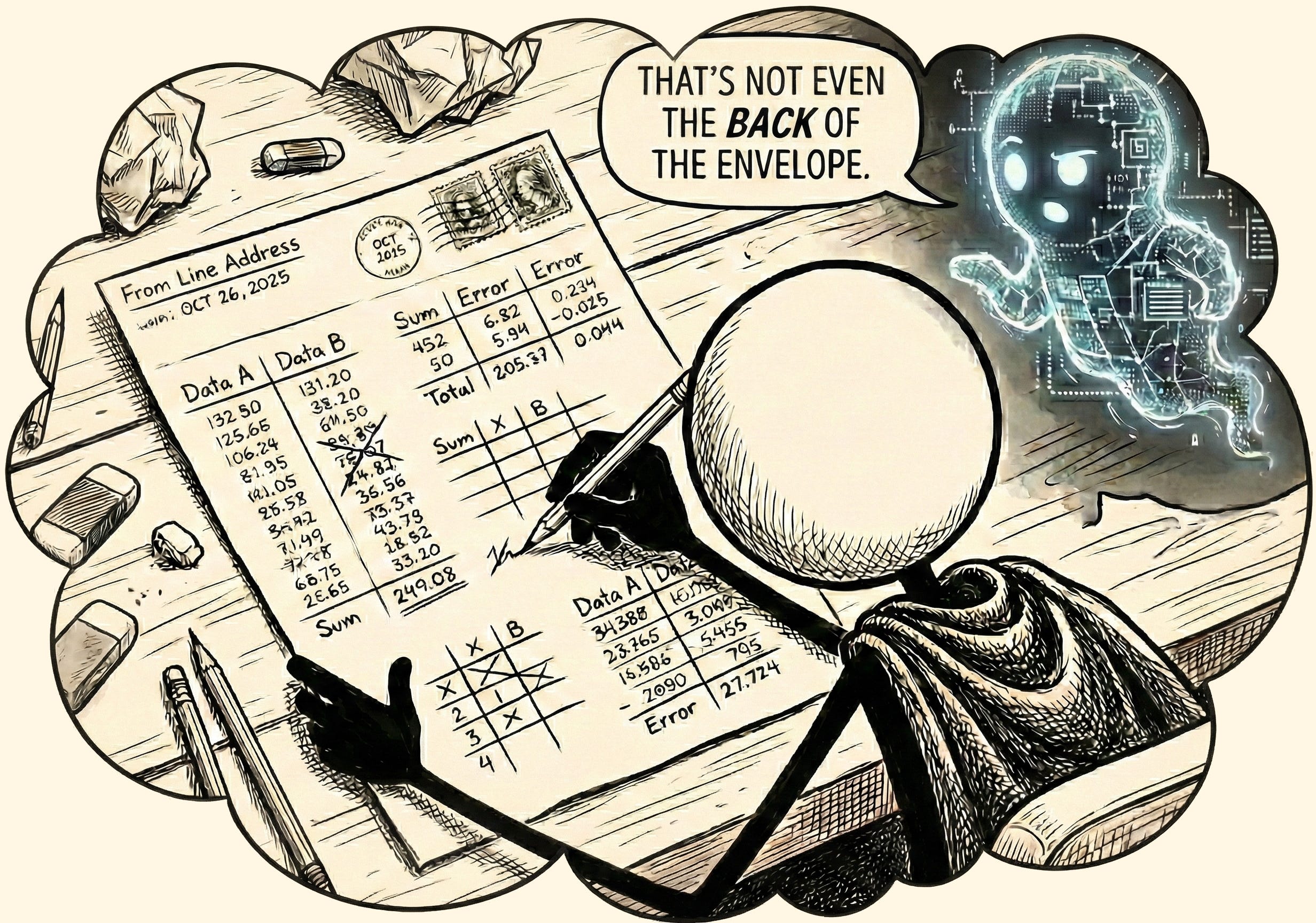
Mark spent some time trying to figure this out himself with a bit of help from Google and a little bit of AI support but he wasn’t getting anywhere fast. The issue in this case was that Mark was trying to use his AI assistant as a calculator and numerical estimator. If you have used AI for any length of time, you know that LLMs are terrible at arithmetic! They are language engines, not calculators.
I suggested that, instead of asking the AI for the answers conversationally, Mark should ask the AI to write the code (as an interactive app) that would allow Mark to explore the problem in more detail. The AI writes the logic, but the code does the math. Essentially, we introduce an additional step so that:
Question → Answer becomes Question → Code → Answer
Fifteen minutes later (and with a few more pointers), Mark and his team had built their first (simple) interactive tool. After a few more iterations, they ultimately decided this particular idea didn’t have any legs but, perhaps more importantly, the team had added a powerful new approach to their tool-belt and, I’m happy to report, they’ve built more since!
Warnings
If it’s not already obvious to the reader by this point, there are of course some risks to this approach. The main one being that there is every possibility that AI is translating your words and requirements into the wrong code and thereby giving you a false sense of security/accuracy.
This is a hard problem to solve completely and there’s a hell of a lot to say on this topic. That being said, in some ways this approach can actually be more transparent than using AI in a conversational style; the internals of the tool are available for inspection and, even if you can’t write computer code, it’s often possible to sanity check the key calculations involved (or even ask the AI to elaborate).
For now, just know that these tools are not always perfect and that caution must be exercised when using any AI output as part of a critical workflow or decision.
But please don’t let that put you off having a go! Almost every firm I work with has tricky estimation problems or fantastic IP to unlock. What they don’t always have is the time to do this stuff. Now they do.
P.S. I’m experimenting with video posts right now. I do these a lot for clients and figured there’s no reason not to have a go here. It goes into a bit more detail and includes a realtime example of tool-creation.